Sales performance management for a team you cannot see working
Imona turns the activity that precedes a result — visits, meetings booked, follow-ups closed, pipeline hygiene — into daily missions with next-step guidance, so coaching stops being a weekly retrospective about a week that already happened.
Your week
Territory NL-West · Week 31- Complete visit planlive8/12Visits completedIn progress · 200 XP
- Book next stage on ageing dealslive2/5Meetings bookedIn progress · 180 XP
- Close last week's commitmentschecklist7/7Follow-up closureComplete · 120 XP
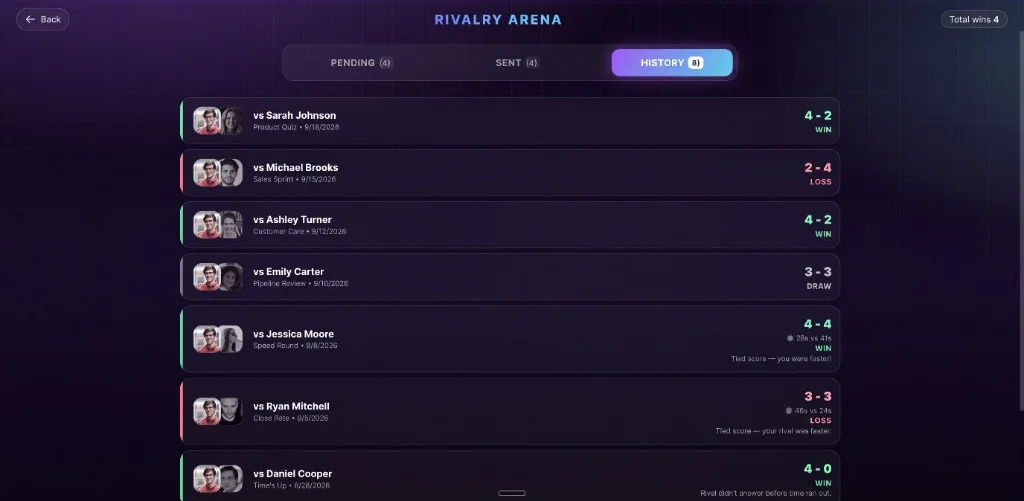
- Duel won 4–2
Field sales is the hardest workforce in the business to manage, because almost everything that decides the result happens with nobody watching. Your CRM holds what the rep chose to type in, afterwards.
The top 20% carry the number and the rest plateau
You know exactly who your strong reps are. You also know that the middle 50% have sat at the same quota attainment for two years, and that one-to-one coaching does not scale to move them.
Coaching is a retrospective about a week that has gone
The weekly one-to-one reviews a pipeline that is already what it is. Nothing in that conversation changes what the rep does on Tuesday, because Tuesday has already happened.
Ramp takes two quarters and the new hires know it
A new rep is unproductive for months, learns from ride-alongs with whoever is available, and has no visible sense of whether they are on track or behind.
Activity is invisible until it becomes a bad quarter
By the time thin pipeline coverage shows up in the forecast, the visits that should have filled it were skipped eight weeks ago.
Financial advisors on branch visits at a global insurance group
MetLife runs branch-visit and daily activity planning for 150 financial advisors on Imona. Sahibinden runs new-sales, package-upgrade, visit and cross-sell targets for 500 users across field sales, telesales and customer experience teams, as a region-based team competition. Both are motions where the work happens away from a manager and the only reliable feedback used to be the number at the end of the month.
MetLife — 150 financial advisors
A global insurance group's advisor network, planned on the phone the advisor already carries.
Metrics you already report, as actions people can take today
Quota attainment is an outcome, not a lever. Imona works on the activity that produces it, which is the part a rep actually controls day to day.
Visits completed
Complete your visit plan for the week, logged from the field
Daily progress on a phone rather than a Friday CRM catch-up
Meetings booked
Book the next stage on every open opportunity before it goes cold
Mission triggers off opportunity age in your CRM
Pipeline coverage
Bring coverage above the multiple your forecast needs
Team goal, so thin coverage is visible before it becomes a forecast miss
Follow-up closure
Close out every commitment made in last week's meetings
The single most-skipped behaviour, made a visible daily target
CRM hygiene
Bring your open opportunities to a complete, current state
Rewards accuracy directly instead of chasing it through management
New-rep ramp
Progress through the territory and product route until you run your own patch
A defined route with stages, replacing open-ended ride-alongs
| # | Team | Activity index | Change |
|---|---|---|---|
| 1 | Team North | 112 | +9 |
| 2 | Team Randstad | 106 | +3 |
| 3 | Team WestYou | 101 | +14 |
| 4 | Team South | 88 | -4 |
The coaching conversation, on Tuesday morning instead of Friday afternoon.
The mentor looks at a rep's own lost-deal pattern, identifies that they lose on budget deferral rather than on product, and gives them that one scenario before their next three meetings. It does not tell them to "improve discovery".
The mentor looks at a rep's own lost-deal pattern, identifies that they lose on budget deferral rather than on product, and gives them that one scenario before their next three meetings. It does not tell them to "improve discovery".
Sales managers see which reps are drifting from their own activity baseline this week, which is early enough to matter, instead of reading a forecast miss two months later.
For managers: Sales managers see which reps are drifting from their own activity baseline this week, which is early enough to matter, instead of reading a forecast miss two months later.
What buyers in this workforce ask before they book
Reps will game the activity metrics.
Some will, if activity is the only thing measured. That is why activity missions are paired with the outcome they are supposed to produce, and why a mission like follow-up closure is validated against a CRM state change rather than a self-report. If a rep games the count without the outcome, the pairing makes it visible rather than hiding it.
We already have CRM dashboards and a sales analytics tool.
Those measure the pipeline. Neither has a mechanism to change what a rep does on a Tuesday. Imona is not another reporting layer — it reads your existing measures and turns them into daily targets with practice attached. If dashboards moved the middle 50%, they would already have moved it.
Our best reps will resist being ranked next to weaker ones.
Ranking on raw quota attainment does exactly that. Standing is normalised — by territory, tenure and bracket — so a strong rep competes against comparable reps, and the individual mentor view is private. In practice the resistance comes from unfair comparison, not from competition.
Our reps are offline in customer buildings and rural territories.
The interface is mobile-first and sized for short interactions between visits. [NEEDS INPUT: confirm offline capability of the mobile client — whether missions and tasks are available without connectivity and sync afterwards]
Does this track our reps' location?
It does not require location tracking to function. Visit completion can be driven by the CRM or calendar record your reps already create. Where a customer wants location-verified visits that is a configuration decision with clear works-council implications, and it is not the default.
Is this more admin for a rep who already complains about CRM?
It reads from CRM rather than asking for a second entry. The rep-facing surface is a progress view and a target, not a form. Where it does touch CRM hygiene, it makes accuracy a rewarded behaviour instead of a manager's chase.
A controlled rollout, not a big-bang launch
Days 1–30
One team, activity that already exists
- Connect CRM activity, opportunity and pipeline data
- Define the activity set that actually leads your number, with your sales leadership
- Set standing brackets by territory and tenure so comparison is fair
- Launch to one region with a matched control region
Days 31–60
Mentor layer and ramp route
- Turn on per-rep next-best-action from each rep's own lost-deal pattern
- Replace ride-along onboarding with the structured territory and product route
- Add manager drift views against individual activity baseline
- Add objection scenarios for the two patterns costing the most deals
Days 61–90
Sales-organisation-wide
- Extend to remaining regions and segments
- Move scenario authoring to your enablement team via the AI Game Designer
- Review pilot versus control on activity and on attainment of the middle quartiles
Short answers for search and procurement
How is this different from a sales dashboard or CRM report?
A dashboard measures pipeline. Imona reads the same measures and turns them into daily missions with practice tasks attached, which is a mechanism to change behaviour rather than to report it.
Can Imona reduce new sales rep ramp time?
It replaces open-ended ride-along onboarding with a structured territory and product route with visible stages, so both the rep and the manager can see whether ramp is on track.
Which field-sales deployments can Imona reference?
MetLife for branch-visit and daily activity planning across 150 financial advisors, and Sahibinden for a region-based team competition across 500 field sales, telesales and customer experience users.
Book a 30-minute field-sales walkthrough
Bring your activity metrics and we will map them to missions on the call.
- We use your metric names and your org structure, not a generic demo tenant
- You see the level map, the mission board and the mentor guidance for your workforce
- You get the security and integration answers in the same call, not in a follow-up
- 30 minutes. If it is not relevant in the first five, say so and we will stop.